

One example is a computer game on Windows called “FreeCell.” It has 32,000 unique games in memory that randomly come up when you play a new game. If you keep track of the games you have worked, how many games would you expect to play before you get a repeat?
The key here is to calculate the probability of not getting a repeat. The probability of not getting a repeat on the first five games is:
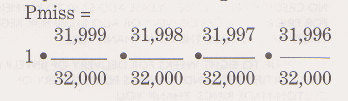
On the fifth game, for instance, you have 31,996 chances out of the 32,000 possibilities of continuing to not get a repeat.
So, keep on going and you will be amazed to find that there is a 50 percent probability of getting a repeat before only 210 games, a 75 percent probability of getting a repeat before 300 games, and a 98 percent probability of getting a repeat before 500 games! I’m sure you would have thought that many more games would need to be worked before getting a repeat!
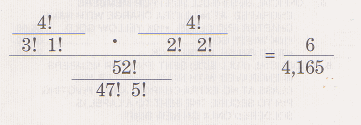
Another interesting probability problem is one that can be depicted with a branching tree. An example is: what is the probability of being dealt a full house in poker? A full house is a five-card hand with one three-of-a-kind and one pair. Draw a tree! Refer to the sketch on this page. This yields 36/41,650 chances of getting AAABB and 24/41,650 chances of getting AABBB, or a total of 6/4,165 chances of being dealt a full house.
You could cookbook the problem as also shown on this page, but I think you will agree that you get more feel for the problem by constructing a tree.
It is good practice to calculate the probability for all options to ensure that they add up to one. Other options for the full-house problem are no pairs, one pair, two pairs, three-of-a-kind, and four-of-a-kind. These all have denominators of 4,165 with numerators of 2,112; 1,760; 198; 88; and 1. Note, that 2,112 + 1,760 + 198 + 88 + 1 + 6 = 4,165, so this confirms that-the calculations are correct.
Your homework problem is to construct trees for these other five options. Have fun!
Construct-a-tree approach:

Cookbook Approach:
Source: The Bent (Tau Beta Pi), page 49 (Spring2001)
Subjects: Articles & Links, Excerpts, Math & Science, Miscellaneous


